A Texas hailstorm can pass through quickly, but the damage it leaves behind may stay hidden for months. If you own a home in Seguin, knowing how to spot hail damage on your roof can help you catch problems before they turn into leaks, damaged decking, or expensive interior repairs. The challenge is that hail damage does not always look dramatic. You might not see missing shingles or a hole in the roof. Sometimes the evidence is nothing more than a cluster of dark marks, loose granules, or small dents in a roof vent.
That is why a careful inspection matters.
You do not need to climb onto your roof immediately after every storm. In fact, you probably should not. There are several safer ways to identify warning signs from the ground, around your property, and inside your home.
Here is what to look for.
Why Hail Can Cause Serious Roof Damage in Seguin
Hail hits a roof with concentrated force.
The harder the impact, the greater the chance that shingles, tiles, flashing, vents, and other roofing components will be damaged. However, hailstone size is only part of the equation.
Several factors affect how much damage a storm can cause:
- The size and density of the hailstones
- Wind speed and direction
- The age of your roofing materials
- The existing condition of the roof
- The slope and orientation of each roof surface
- The type of roofing material installed
- How long the hailstorm lasts
Wind is especially important.
A hailstone falling almost vertically may produce one level of damage, while the same hailstone driven sideways by strong winds can strike shingles with far greater force. This also means one side of your roof can sustain considerably more damage than another.
Older roofs can be particularly vulnerable. Asphalt shingles naturally lose some flexibility and protective granules as they age, so a storm that causes little visible damage to a newer roof may leave much clearer marks on an older one.
What Size Hail Can Damage a Roof?
There is no single hailstone size that guarantees roof damage.
A relatively small hailstone hitting an old or deteriorated roof in strong winds may cause more damage than a larger stone falling during calmer conditions.
Still, hail size gives homeowners a useful starting point.
| Approximate Hail Size | Comparable Object | Possible Roof Effect |
|---|---|---|
| ½ inch | Marble | Usually minor, although aging materials may be affected |
| 1 inch | Quarter | Possible granule loss and shingle bruising |
| 1.5 inches | Ping-pong ball | Greater chance of visible shingle and metal damage |
| 2 inches | Egg | Significant potential for roof, vent, and gutter damage |
| 2.5+ inches | Tennis ball or larger | High potential for severe property and roofing damage |
Think of this table as a guide rather than a diagnosis.
Roof condition matters just as much.
How to Spot Hail Damage on Your Roof From the Ground
Start low.
Before considering a ladder or rooftop inspection, walk around your home and examine the roof from several angles. Binoculars can be extremely useful here.
When trying to spot hail damage on your roof, look for obvious changes such as missing shingles, uneven shingle edges, exposed areas, or damaged vents.
Then broaden the inspection.
Check the property surrounding the roof.
Look for:
- Pieces of roofing material in the yard
- Large quantities of shingle granules near downspouts
- Dents in gutters
- Damaged siding
- Torn window screens
- Dented metal flashing
- Damaged air-conditioning units
- Broken skylights
- Chips or dents on painted metal surfaces
These surrounding clues matter.
If hail was strong enough to dent metal gutters, damage siding, or leave marks on vehicles parked outside, there is a reasonable basis for taking a closer look at the roof.
Check Your Gutters and Downspouts
Gutters can tell you quite a lot about what happened during a storm.
Start by looking for dents.
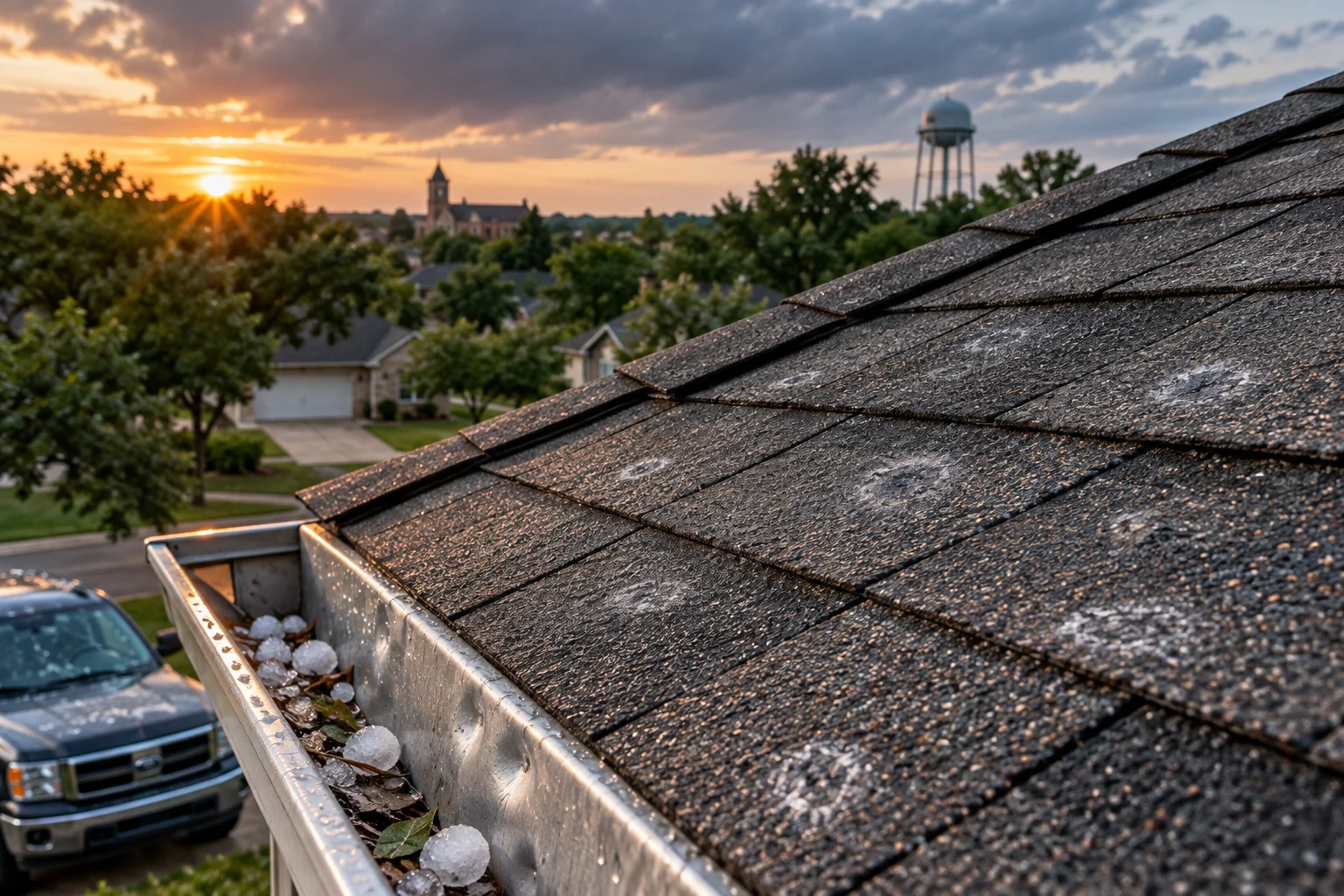
Fresh hail impacts may leave round or irregular indentations on aluminum gutters and downspouts. You may also notice chipped paint or small impact marks.
Next, examine areas beneath downspout outlets.
Asphalt shingles have a layer of protective granules on their surfaces. Those granules help shield the underlying material from sunlight and weather. Hail impacts can knock some of them loose.
A handful of granules is not automatically alarming. Shingles naturally shed some material over time.
A sudden, unusually heavy collection after a hailstorm deserves more attention.
Look for Missing, Lifted, or Loose Shingles
Hail rarely arrives alone.
Strong thunderstorms often bring considerable wind, and the combination of hail and wind can be particularly rough on asphalt shingles.
Walk around the property and look for:
- Completely missing shingles
- Shingles sitting in the yard
- Lifted shingle tabs
- Torn or curled edges
- Areas where the roof appears uneven
- Exposed underlayment
Missing shingles are easier to notice than hail bruises, which makes them an important early warning sign.
They also need attention quickly.
Once part of the roof system is exposed, rain has a more direct path toward the materials underneath.
How to Spot Hail Damage on Asphalt Shingles
Asphalt shingles are common on Texas homes, and hail can affect them in several ways.
The most recognizable sign is localized granule loss.
You may see a darker patch where granules have been knocked away, exposing more of the asphalt layer underneath. Some marks are roughly circular. Others are irregular.
When professionals spot hail damage on your roof, they may look for several characteristics together rather than relying on one mark alone:
- Dark impact spots
- Missing granules
- Soft or bruised sections
- Cracked shingle surfaces
- Exposed asphalt
- Random impact patterns
- Damage concentrated on storm-facing slopes
This is an important distinction.
A roof that is simply aging often shows more widespread, relatively uniform deterioration. Hail impacts tend to be more random.
What Does a Hail Bruise on a Shingle Look Like?
Not all hail damage breaks a shingle.
Sometimes the impact compresses or weakens the shingle without creating an obvious crack. This is commonly described as bruising.
That makes it tricky.
From several feet away, the roof may look completely normal.
Closer inspection may reveal a slightly darker impact mark or an area where granules have been displaced. The underlying shingle material may also have been weakened.
Over time, repeated heating, cooling, wind, and rain can place additional stress on that damaged area.
This is one reason I would not recommend waiting for a leak before investigating possible hail damage.
A leak tells you water has already found a path inside.
Hail Damage vs. Normal Roof Wear
This is where many homeowners get understandably confused.
Roofs age.
Granules loosen. Shingles fade. Edges become worn. Small cracks can develop. None of those conditions automatically proves that hail caused the damage.
Look at the overall pattern.
| Possible Hail Damage | Typical Aging or Wear |
|---|---|
| Random impact marks | Gradual deterioration |
| Localized granule loss | More uniform granule thinning |
| Damage appearing after a storm | Changes developing over years |
| Dents on nearby metal components | No corresponding impact dents |
| Isolated bruises or cracks | Broad weathering across the roof |
The timing matters too.
If you inspected your property shortly before a storm and the roof appeared normal, then notice fresh impact marks immediately afterward, that context is useful.
Take photos.
Good documentation gives you something concrete to compare later.
Inspect Roof Vents, Flashing, and Other Metal Components
If you are struggling to spot hail damage on your roof, metal roof components may provide clearer evidence than the shingles themselves.
Hail often leaves visible dents in softer metals.
Using binoculars or a camera with zoom, inspect visible:
- Roof vents
- Plumbing vent covers
- Chimney caps
- Metal flashing
- Roof valleys
- Exhaust vents
- Gutters
- Downspouts
Look for fresh, rounded dents or chipped surface coatings.
Multiple dents across several exposed metal components can suggest that the roof experienced substantial hail impact even when shingle damage is harder to see from below.
Look Inside the House Too
Your inspection should not stop outside.
After a severe storm, check your attic if you can access it safely.
Look carefully around roof penetrations, chimneys, vents, and other areas where water might enter.
Warning signs can include:
- Damp insulation
- Darkened roof decking
- Water stains
- Moisture around vents
- Dripping
- Damp wood
- Musty odors
Then inspect your ceilings and upper walls.
New discoloration, bubbling paint, peeling finishes, or brown water marks can indicate moisture intrusion.
The important word here is new.
A stain from a leak five years ago tells you little about yesterday’s hailstorm. Photograph existing stains when you first notice them so you can monitor whether they change.
Can Hail Damage Cause an Immediate Roof Leak?
Yes.
But it does not always happen that way.
A severe impact can crack roofing materials or damage a vulnerable roof component enough to let water enter during the same storm.
Other damage develops gradually.
A hail impact may weaken a shingle without immediately creating an opening. Weeks or months of sunlight, temperature changes, wind, and rain can then make that damaged area worse.
Eventually, water finds a path through.
This is why learning to spot hail damage on your roof before you see water dripping from the ceiling is so valuable.
Early detection gives you more options.
How Different Roofing Materials Respond to Hail
Hail does not affect every roof the same way.
Asphalt Shingles
Look for:
- Granule loss
- Dark impact marks
- Bruising
- Cracking
- Torn edges
Damage can be subtle, particularly from the ground.
Metal Roofing
Metal roofs may show:
- Round dents
- Surface coating damage
- Scratches
- Damage around seams or fasteners
Some dents may be primarily cosmetic, while damage around seams or penetrations may deserve closer attention.
Clay or Concrete Tile
Hail can produce:
- Cracks
- Chips
- Broken corners
- Completely fractured tiles
Cracks may be difficult to see from ground level.
Wood Shakes
Possible signs include:
- Fresh splits
- Impact marks
- Broken edges
- Exposed wood fibers
Each roofing material requires a slightly different inspection approach.
Inspect the Rest of Your Seguin Property
The roof is only one piece of evidence.
After a serious storm, inspect the entire property.
Look at your:
- Vehicles
- Fence
- Outdoor furniture
- Siding
- Window screens
- Garage door
- Mailbox
- Patio covers
- Outdoor HVAC equipment
Suppose your truck has dozens of fresh hail dents, your aluminum gutters are marked, and your window screens are torn.
That does not automatically prove roof damage.
It does, however, make a professional roof inspection much more reasonable.
Should You Climb Onto Your Roof?
For most homeowners, no.
You can gather plenty of useful information without stepping onto the roof.
A recently storm-damaged roof can be particularly hazardous because shingles may be loose, wet, or unstable. Steep slopes add another layer of risk.
There is also another problem.
Walking across questionable roofing materials can cause additional damage or make existing marks harder to interpret.
Instead, use:
- Binoculars
- A camera with optical zoom
- Ground-level photographs
- Upper-story windows
- Safe attic access
If you cannot clearly evaluate the roof from these locations, bring in someone equipped to inspect it safely.
What to Do If You Spot Hail Damage on Your Roof
Once you spot hail damage on your roof, resist the urge to immediately start tearing off shingles or making major changes.
Document first.
A practical sequence looks like this:
- Photograph the roof from the ground. Capture wide views as well as visible areas of damage.
- Photograph surrounding damage. Include gutters, siding, vehicles, screens, and outdoor equipment.
- Check your attic. Look for fresh moisture or changes to insulation and decking.
- Write down the storm date. Keep notes about when you first noticed damage.
- Prevent immediate water intrusion when necessary. Emergency protection may be appropriate if water is actively entering the home.
- Arrange a professional roofing inspection.
- Keep receipts and records. Save documentation related to temporary protection, inspections, and repairs.
- Review your homeowners insurance policy. Coverage, deductibles, exclusions, and reporting requirements vary by policy.
Documentation does not need to be complicated.
Clear photos with dates and a few written notes can be extremely useful.
When Should You Schedule a Professional Roof Inspection?
Not every hailstorm requires major roof repairs.
But a professional inspection makes sense when there is substantial evidence that your property experienced significant hail.
Consider scheduling one when:
- Nearby vehicles have obvious hail dents
- Gutters or roof vents are dented
- Shingles appear damaged
- You find unusual granule buildup
- Roofing materials are lying in the yard
- Interior water stains appear
- Your roof is older
- The storm included unusually large hail or strong winds
Experienced Seguin roofers can examine areas that are difficult or unsafe for homeowners to access.
A good inspection should evaluate more than one obvious mark.
The overall roof system matters.
Why Small Hail Damage Should Not Be Ignored
Small damage can become a large expense.
That does not mean every mark requires immediate roof replacement. Far from it.
But damage should be understood.
When hail strips protective granules from asphalt shingles, more of the underlying material becomes exposed to sunlight and weather. Cracked or weakened areas may deteriorate faster than the surrounding shingles.
Over time, that can contribute to:
- Premature roof aging
- Additional granule loss
- Cracking
- Moisture intrusion
- Damaged roof decking
- Wet insulation
- Interior staining
The earlier you spot hail damage on your roof, the easier it is to understand what happened and decide what action is actually necessary.
How Soon Should You Inspect Your Roof After a Hailstorm?
As soon as conditions are safe.
There is little benefit in walking around during lightning, high winds, or heavy rain.
Once the storm passes, start with a simple property inspection.
Take photographs of anything unusual.
Then check again during daylight if the storm happened at night. Good lighting makes small roof and gutter damage much easier to identify.
If you suspect damage, do not put off an inspection indefinitely simply because the roof is not leaking.
Remember: some problems take time to become obvious.
Common Mistakes After a Hailstorm
Homeowners often make the same few mistakes.
Waiting for Water to Come Through the Ceiling
A roof does not need to leak immediately to be damaged.
Assuming the Roof Is Fine Because It Looks Fine From the Street
Some hail damage is nearly impossible to identify from ground level.
Climbing Onto a Wet Roof
The information you gain is rarely worth the safety risk.
Ignoring Gutters and Vents
These components can provide some of the clearest evidence of hail impact.
Assuming Every Mark Was Caused by Hail
Old wear, foot traffic, falling branches, manufacturing irregularities, and ordinary aging can sometimes resemble storm damage.
Failing to Take Photos
Conditions change.
Documenting what you see shortly after the storm creates a useful record.
Protecting Your Roof After a Seguin Hailstorm
Knowing how to spot hail damage on your roof comes down to looking for patterns, not just one suspicious mark.
Start with the safe, obvious areas.
Check gutters for dents. Look for excessive granules. Examine visible shingles for missing sections, dark impact spots, cracks, and exposed surfaces. Inspect roof vents and other metal components, then check the attic and ceilings for moisture.
And look beyond the roof.
Damage to vehicles, siding, screens, outdoor equipment, and other exposed surfaces can help you understand how severe the hailstorm was.
Most importantly, do not wait for dripping water before taking a possible roof problem seriously.
If you spot hail damage on your roof or find enough surrounding evidence to suspect it, document the condition and arrange a professional inspection. A qualified Seguin roofer can take a closer look at the roofing system, identify areas that deserve attention, and help you understand whether repairs are actually needed.
Hail can be unpredictable.
Your response does not have to be.
A careful inspection after the storm gives you the information you need to protect your home, avoid unnecessary work, and deal with real roofing problems before they become much harder to manage.